How do you use a pregnancy pillow?
Updated .
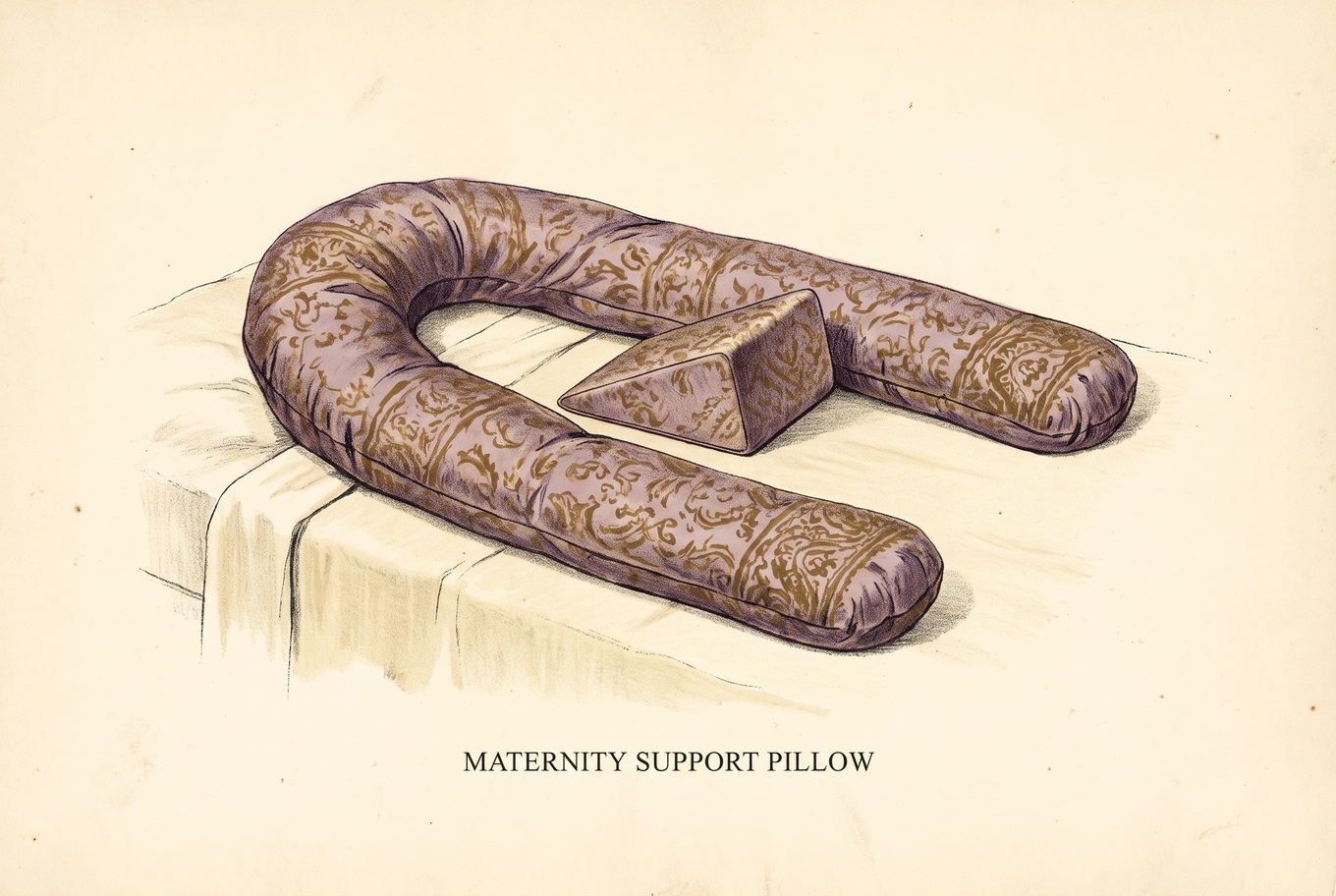
Almost half of pregnant people say they sleep badly. A meta-analysis of 11,002 participants found that 45.7% had poor sleep quality, and that sleep got worse from the second trimester to the third (Sedov et al., Sleep Medicine Reviews, 2018). A pregnancy pillow can help, but only if it holds your body in the right position. From 28 weeks, the position you sleep in also has a medical reason behind it.
Short answer: Lie on your side with one or both knees bent. Put the lower part of the pillow between your knees and ankles, tuck the front section under your bump, and let the back section rest along your spine. From 28 weeks, start every night's sleep and every nap this way (NHS). If you wake on your back, roll onto your side and settle again. A U, a C or a straight body pillow can all hold this position. The shape changes convenience, not the position.
This guide is for: people in the second or third trimester who have a pregnancy pillow, or a stack of ordinary pillows, and want to know where each part goes.
Key Takeaways
Three points carry most of the value here: the position to start in, the evidence behind it, and what a pillow can and cannot do.
- Go to sleep on your side from 28 weeks. UK research found that going to sleep on your back carried 2.3 times the risk of late stillbirth (Manchester University NHS Foundation Trust, 2017).
- Use 2 supports: one between your knees and one under your bump. This is the setup ACOG describes, with a full-length body pillow as the alternative (ACOG).
- Expect to wake on your back sometimes. In a 2025 trial, people using a pillow built to stop back sleeping still spent about 1 hour a night on their backs (Wilson et al., BJOG, 2025).
On This Page
Each section below answers one question, in the order most people meet them, from first setup to fixing a specific ache in late pregnancy.
What does a pregnancy pillow need to do while you sleep?
It holds you on your side with knees bent, fills the gap under your bump, and stops your top leg from dragging your hips out of line.
Every shape of pregnancy pillow does the same three jobs. The first is keeping you on one side. The second is filling the space between your knees, so your top leg does not pull your pelvis forward and twist your lower back. The third is taking some of your bump's weight. That lets the muscles along your side relax.
ACOG's advice on back pain describes the same setup in plain terms. Side sleeping is best later in pregnancy, it says, with one or both knees bent. A pillow between the knees and another under the belly may help, and a full-length body pillow is the alternative (ACOG). A pillow behind the back can add extra support too, according to Stanford Medicine Children's Health.
Once you are lying down, check two things. Your top knee should sit about level with your hip, not dropped toward the mattress. Your shoulders and hips should face the same way. These checks are our judgement, not a published rule. Still, they are the quickest way to tell whether the part between the knees is thick enough.
If the knee check fails, add height between your legs before changing anything else. Most early discomfort comes from that gap.
When should you start sleeping with a pregnancy pillow?
Start when your bump makes sleep uncomfortable, and have the habit set by 28 weeks, when health services advise going to sleep on your side.
No rule says when to start. You might begin when hip ache or your bump makes sleep hard. One date does matter. The NHS says that going to sleep on your back after 28 weeks of pregnancy can increase the risk of stillbirth, and that the safest position to fall asleep in is on your side, either left or right (NHS).
That advice rests mostly on case-control studies. These asked people about their sleep after the outcome was already known. A large prospective US study did not find the same link. The table shows both kinds of result, which explains why advice sounds firmer in some countries than in others.
| Study | Who was studied | What it found |
|---|---|---|
| MiNESS, UK (Manchester University NHS FT) | 291 stillbirths, 735 live births | Going to sleep on the back: 2.3 times the risk of late stillbirth |
| Pooled analysis of earlier studies (University of Huddersfield) | Case-control data from several countries | 2.6 times the risk from 28 weeks |
| nuMoM2b, US (Obstetrics & Gynecology) | 8,706 people in a first pregnancy | No link found for back or right-side sleep through 30 weeks |
Your best move is to start the habit early. That way it is automatic for you by 28 weeks, when it counts. Going to sleep on one side costs very little, and a pillow makes the position easier to hold. If you have not bought one yet, our guide on which pregnancy pillow to buy and when to start covers the choice.
How do you set up a U-shaped pregnancy pillow?
Lie inside the U on your side, hug the front arm, tuck its lower end between your knees, and let the back arm keep you from rolling over.
A U-shaped pillow supports both sides of your body, so you can turn over without moving it. That is its main advantage. Its size is the cost. The table in the next section lists one U-shaped model's size from its seller page. Its listed width covers about half of a 60-inch queen (Avocado mattress size guide).
To set it up, lay it with the closed curve at the head of your bed and the open ends toward the feet. Lie in the middle, on one side. Hug the front arm and pull its lower half between the knees and ankles. Your head rests on the curve. If the curve feels too low, put your usual pillow on top of it. The back arm runs along your spine and gives you something to lean into.
To turn over, you roll inside the U while the two arms swap jobs. Nothing has to be lifted. That matters in the middle of the night with a heavy bump. The front arm should reach your bump without you stretching for it. If it sits too far away, push the pillow closer from behind before settling.
A U does crowd a shared bed. For a fuller comparison, see whether a U-shaped body pillow is worth it or a long one will do.
How do you use a C-shaped or J-shaped pregnancy pillow?
Rest your head on the curved top, run the long side along your back or your front, and hook the bottom curve between your knees.
A C-shaped pillow wraps around one side of your body rather than both. The table below gives one C-shaped model's listed size and weight from a retailer page. Leachco says that on its C-shaped pillow the slightly curved end tucks snugly between the knees, and that the middle section supports either the back or the front (Leachco).
You choose which way to face. Facing into the C puts the long side along your front, where it holds the bump and the top arm. Facing away puts it along your back. That makes rolling harder but leaves the bump on the mattress. A J shape is a shorter version with one hooked end. Your head goes on the straight part and the hook goes between your knees.
The catch with a one-sided pillow is turning over. You have to lift and flip it. That can wake you fully.
| Shape | Example size from a seller page | Where your knees go | Turning over | Our judgement |
|---|---|---|---|---|
| U | 53 x 31 x 7 in (PharMeDoc) | Lower half of either arm | Roll inside it | Suits people who turn often; widest footprint |
| C | 48 x 26 x 7.5 in, 4.67 lb (REBEL) | Bottom curve | Lift and flip | Suits one favored side |
| Compact side pillow | 32 x 22.5 x 7 in, 2.8 lb (Leachco) | Lower pad | Lift and flip | Least bed space; no head support |
| Straight pillow or bed pillows | Varies | Lower end, or a separate pillow | Move each piece | Costs least; drifts in the night |
What if you only have a straight body pillow or regular pillows?
You can copy most of what a shaped pillow does with a straight body pillow or two bed pillows: one between the knees and one under the bump.
You do not need a shaped pillow for the position. ACOG's own answer lists two ordinary pillows first: one between the knees and another under the belly, with a full-length body pillow as the other option (ACOG). UPMC notes that there are many different pillows marketed toward pregnant women, so there is no one "best pillow." (UPMC HealthBeat).
With a straight body pillow, lie on one side and hug it so it runs from your chest to your ankles. Pull the lower end up between your knees and rest your top ankle on it too. An unsupported ankle lets the top leg drop. The pelvis twists with it. Then slide a folded bed pillow or a small wedge under your bump.
If you tend to roll onto your back, lay a second pillow lengthwise behind you. Tuck its edge under the hip. That keeps it from sliding away when the sleeper shifts.
Loose pillows drift apart during the night. You will probably wake sometimes to rebuild the setup. That is normal. It is the main thing a one-piece pillow saves.
Which side should you sleep on with a pregnancy pillow?
Either side is acceptable in NHS and Australian advice; some US sources favor the left. Going to sleep on your side matters more than which one.
Australia's Safer Baby program is direct: either the left or the right side is fine for going to sleep (Safer Baby). Some US sources lean left. Stanford Medicine Children's Health says the left side is especially good because it lets the most blood flow to the baby (Stanford Medicine Children's Health). The Sleep Foundation says both sides are generally considered safe during pregnancy, but the left is often recommended as the better option (Sleep Foundation).
We read six public health and hospital pages on September 27, 2026, and counted what each says about which side to sleep on.
Two say either side is fine: the NHS and Safer Baby. Two favor the left: Stanford Medicine Children's Health and the Sleep Foundation. Two say side, without naming left or right, in the passages we read: ACOG's back pain FAQ and its back-sleeping answer.
For pillow setup, the count points one way. All six agree on side sleeping; they differ only on which side. Set up your pillow so you can switch sides easily. Hips get sore after hours of pressure. If you strongly prefer one side, a C facing that way works well. If you alternate, a U or loose pillows spare the flip.
Will a pregnancy pillow stop you rolling onto your back?
Not reliably. In one trial, people using a pillow built to prevent back sleeping still spent about an hour a night on their backs.
Not on its own. People move in their sleep, and the research on devices that try to stop this is mixed. Researchers who tested a positional belt found that most pregnant women spend a sizable share of sleep time on their backs, and the belt cut that time over one night (AASM).
A pillow built for the same purpose did worse. In a crossover trial in Australia, the authors found no evidence that a pillow designed to discourage back sleeping worked in late pregnancy (Wilson et al., BJOG). An ordinary pregnancy pillow is not designed to hold anyone more firmly than that one did.
So treat the pillow as comfort, not a guard rail. The guidance is about the position you go to sleep in. The NHS says not to worry about waking on your back; just turn onto your side before going back to sleep. Safer Baby gives the same advice for naps as well as nights.
What a pillow can do is make rolling a little harder. A back section wedged close against the spine is the most it can offer.
How do you adjust the pillow for back pain, hip pain or heartburn?
Add height under the bump for back ache, raise the knee section for hip pain, and lift your upper body on a slope for heartburn at night.
Most adjustments change the height at one point. For back ache, ACOG's back pain guidance pairs side sleeping with a pillow under the belly (ACOG). For more detail, see whether a body pillow helps with back pain. For heartburn at night, the American Pregnancy Association suggests propping the upper body with pillows. For shortness of breath, it suggests lying on one side or propped up with pillows (American Pregnancy Association).
Keep any slope gentle and stay on one side while using it. A pile of pillows that bends the body at the waist pushes the bump up into the ribs. Raise from the chest up, not the head alone.
The table below is our judgement, built from the guidance above. No pillow maker publishes it. Nothing in it was tested here.
| Problem | Change to make | Where it goes | What it will not fix |
|---|---|---|---|
| Lower back ache | Thicker support under the bump | Front arm, or a wedge | Pain that lasts through the day; ask your clinician |
| Hip or pelvic ache | Raise the knee section until the top knee is level with the hip | Between knees and ankles | Pressure on the lower hip; switch sides |
| Heartburn at night | Gentle slope from the chest up | Wedge or folded pillows under the upper body | Large late meals |
| Short of breath | Side-lying with the upper body raised | Head end of the pillow, plus a wedge | Breathlessness that does not ease; seek care |
| Waking on your back | Back section snug against the spine | Back arm, or a pillow lengthwise behind you | Rolling in deep sleep |
Common questions
Short answers to the questions people ask most after the first few nights with a pregnancy pillow, from washing it to using it after birth.
Can you use a pregnancy pillow in the first trimester?
Yes, if it helps. Early in pregnancy most positions are fine when comfortable. The side-sleeping advice tied to stillbirth risk applies from 28 weeks. That makes the first trimester a good time to get used to the pillow.
Should the pillow go between your knees or your ankles?
Both, if the pillow is long enough. Support at the knees alone lets the top ankle drop. That twists the pelvis. With a short pillow, add a folded towel or small pillow at the ankles.
Is it safe to sleep on your right side with a pregnancy pillow?
The NHS and Safer Baby both say either side is fine to fall asleep on. Some US sources prefer the left. None of the 6 pages we read says to avoid the right side.
How do you wash a pregnancy pillow?
Care instructions differ from pillow to pillow, so follow the label. Leachco says to spot clean its pillow and not machine wash it, though the cover goes in the machine (Leachco). Boppy says its Total Body pillow is machine washable in a commercial-size washer (Boppy).
Can you keep using it after the baby is born?
Many people use it for their own support while sitting up to feed or recovering. Keep it out of the baby's sleep space entirely, because a large, soft pillow does not belong near a sleeping infant.
What should you do if you wake up on your back?
Roll onto your side and go back to sleep. Official guidance from 28 weeks is about the position you fall asleep in. Waking on your back is common. Readjust the back section of the pillow so it sits closer.
Sources
Gathered here, the outside pages this body pillow guide quotes, each beside the part of the guide that needed it.
- Sedov et al., Sleep Medicine Reviews, 2018 (pubmed.ncbi.nlm.nih.gov), needed in the opening.
- NHS (nhs.uk), needed in “When should you start sleeping with a pregnancy pillow?”; “Which side should you sleep on with a pregnancy pillow?”.
- Manchester University NHS Foundation Trust, 2017 (mft.nhs.uk), needed in “Key Takeaways”; “When should you start sleeping with a pregnancy pillow?”.
- ACOG (acog.org), needed in “Key Takeaways”; “What if you only have a straight body pillow or regular pillows?”; “Which side should you sleep on with a pregnancy pillow?”.
- Wilson et al., BJOG, 2025 (pubmed.ncbi.nlm.nih.gov), needed in “Key Takeaways”; “Will a pregnancy pillow stop you rolling onto your back?”.
- ACOG (acog.org), needed in “What does a pregnancy pillow need to do while you sleep?”; “Which side should you sleep on with a pregnancy pillow?”; “How do you adjust the pillow for back pain, hip pain or heartburn?”.
- Stanford Medicine Children's Health (stanfordchildrens.org), needed in “What does a pregnancy pillow need to do while you sleep?”; “Which side should you sleep on with a pregnancy pillow?”.
- University of Huddersfield (hud.ac.uk), needed in “When should you start sleeping with a pregnancy pillow?”.
- Obstetrics & Gynecology (journals.lww.com), needed in “When should you start sleeping with a pregnancy pillow?”.
- Avocado mattress size guide (help.avocadogreenmattress.com), needed in “How do you set up a U-shaped pregnancy pillow?”.
- Leachco (leachco.com), needed in “How do you use a C-shaped or J-shaped pregnancy pillow?”.
- PharMeDoc (amazon.com), needed in “How do you use a C-shaped or J-shaped pregnancy pillow?”.
- REBEL (fromrebel.com), needed in “How do you use a C-shaped or J-shaped pregnancy pillow?”.
- Leachco (leachco.com), needed in “How do you use a C-shaped or J-shaped pregnancy pillow?”.
- UPMC HealthBeat (share.upmc.com), needed in “What if you only have a straight body pillow or regular pillows?”.
- Safer Baby (saferbaby.org.au), needed in “Which side should you sleep on with a pregnancy pillow?”.
- Sleep Foundation (sleepfoundation.org), needed in “Which side should you sleep on with a pregnancy pillow?”.
- AASM (aasm.org), needed in “Will a pregnancy pillow stop you rolling onto your back?”.
- American Pregnancy Association (americanpregnancy.org), needed in “How do you adjust the pillow for back pain, hip pain or heartburn?”.
- Leachco (leachco.com), needed in “Common questions”.
- Boppy (boppy.com), needed in “Common questions”.