The plain answer
Most makers do not say. Nine of the 25 natural-fill body, pregnancy and wedge pillow pages we read state the fill amount (our count). Where a figure is given, one wool body pillow is listed at 4.5 lb of fill (Holy Lamb Organics) and a shredded latex body kit at more than twice that (DIY Natural Home). The same pillow can carry different weights on different sellers' pages, so treat any single figure as a claim.
This guide is for: people reading natural body, pregnancy and wedge pillow pages who want to know what those pages say about the fill and what they leave out.
The full count is free to download as a CSV file, so you can check any figure on this page yourself.
Key Takeaways
- 9 of 25 makers' pages state how much fill is inside, while nearly all state the dimensions (dataset).
- One wool body pillow is listed at 4.5 lb of fill by its maker (Holy Lamb Organics) and about a pound less by a reseller (Pillows.com).
- 7 of 25 pages name a certificate with its number, which gives you something specific to ask the maker about (dataset).
How many makers state how much fill is in their body pillow?
Nine of the makers' pages we read state the fill amount. Dimensions are nearly universal; named certificates and fill weights are rare.
A product page is often all you see before a pillow arrives. Its statements are what you compare. This count put seven plain questions to each page.
We read 25 makers' own product pages on 2026-11-11, and all of them were readable. The seven questions fall into three buckets (dataset):
- Stated by most pages: the dimensions and a cover that comes off to be washed.
- Stated by about half: the country of making, a trial or return window, and fill you can add or remove.
- Stated by a minority: how much fill is inside and a certificate named with its number.
The counts below come from the dataset. The share column is our arithmetic, each count divided by the pages read.
| What the page states | Pages | Share (our arithmetic) |
|---|---|---|
| The pillow's dimensions | 23 of 25 | 92% |
| The cover comes off and can be washed | 16 of 25 | 64% |
| The country it is made in | 14 of 25 | 56% |
| A trial or return window in nights or days | 13 of 25 | 52% |
| Fill can be added or removed | 11 of 25 | 44% |
| How much fill is inside | 9 of 25 | 36% |
| A certificate named with its number | 7 of 25 | 28% |
The widest gap is between size and fill. You can nearly always learn how long a pillow is. On most pages, you cannot learn how much wool, latex or kapok fills that length. Two pillows of one size can hold very different amounts, and the amount changes what you lift each night.
How much fill do makers say goes into a natural body pillow?
Where makers print a figure, wool body pillows run a few pounds and shredded latex runs heavier, so you need both the size and the fill type.
Where a maker prints a figure, it is usually in pounds. It sits next to the size. The table lists the figures we found on seller pages, with the size each one belongs to.
| Pillow and size | Fill | Figure on the page | Source |
|---|---|---|---|
| Body, 17 x 53 in | Organic wool | 4.5 lb of fill | Holy Lamb Organics |
| Buddy, 9 x 42 in | Organic wool | 2.6 lb of fill | Holy Lamb Organics |
| Body, size not tied to figure | Organic wool | 2 to 7 lb of fill | The Futon Shop |
| Body kit, 18 x 54 in | Shredded latex | 10 lb of fill | DIY Natural Home |
| Body, 52 x 10 in | Shredded latex | 8 lb, fill or whole pillow not said | Back Support Systems |
| Large body pillow | Kapok, adjustable | 8 pounds as item weight, not fill | Amazon listing |
On these pages, shredded latex comes out heavier than wool for a similar size. The same latex shop's standard-size kit holds less than half the fill of its body kit (DIY Natural Home).
Read the wording around any weight. A weight printed on a page is not always the fill. A marketplace field called item weight describes the whole listing, which can include the cover. Check which one you are reading. When you compare two pillows, you want the fill figure on its own, stated as fill.
Weight is only part of the picture. How each fill feels under your arm or knee is set out on the page comparing shapes and fills.
Why does the same body pillow show different fill weights on different pages?
One wool body pillow is listed at four different fill weights across six seller pages, and the gap between the top and bottom is about a pound.
Resellers often copy a maker's description, so you might expect one figure everywhere. You will not find one. We found four different fill weights for one wool body pillow on six seller pages read the same day.
| Seller page | Version named | Fill weight stated |
|---|---|---|
| Holy Lamb Organics (maker) | Certified organic | 4.5 lb |
| Oly Bed Store | Certified organic | 4.5 lb |
| The Natural Sleep Store | Certified organic | 4.5 lb |
| Pram n Proper | Organic | 4.21 lb |
| The Natural Sleep Store | Natural eco wool | 4 lb |
| Pillows.com | Eco wool | 3.46 lb in specs, 4 lb in text |
| Spread (our arithmetic) | 1.04 lb, about 17 oz |
Part of the gap has a plain reason. The maker offers natural wool from small US farms and an organic option from New Zealand (Oly Bed Store), and the organic pages sit at the top of the range. Pages for one version still disagree. One reseller even prints two figures on the same page.
The spread is our arithmetic, not a figure any seller publishes. Start with the maker's own page. Then ask the maker which figure is current and which version it belongs to. A reseller's copy can lag behind a change the maker made months ago.
Does the law make a maker tell you how much fill is inside?
No rule we read asks for fill weight on a finished pillow. California's law label gives fill materials by percentage instead.
California requires the law label on bedding to state the kinds, types and percentage of filling materials, figured by weight and listed largest first (California's labeling regulation). So a pillow filled only with wool reads as all wool, whether it holds a little wool or a lot. The label names the material. It never gives the amount.
Net weight does appear in the rules, for other things. California's label rules call for the net weight of filling, in pounds and ounces, on bedding such as sleeping bags, mattresses, box springs and pads (California's net weight rule). Pillows are not in that list. Loose fill sold in bulk also carries its net weight (ComplianceGate). That is why a refill bag tells you its weight when the finished pillow does not.
Federal rules point the same way. The FTC's labeling booklet lists pillows among covered bedding, and lists upholstery or mattress stuffing as not covered unless it is reused (FTC booklet, copy hosted by a label maker). Either way, the federal rule is about which fiber, not how much.
| Rule | What it asks about the fill | Fill weight on a finished pillow? (our reading) |
|---|---|---|
| California law label | Kinds and percentage of fill by weight | Not named for pillows |
| California net weight line | Net weight in pounds and ounces | Named for sleeping bags, mattresses, box springs, pads |
| FTC Textile Act booklet | Fiber content on covered bedding | Not required |
If the weight matters to you, ask the maker for it in writing. You are allowed to ask.
What else do makers' pages state, and what do they leave out?
Most pages give size and a washable cover. About half state where the pillow is made or how long you can try it, and fewer let you change the fill.
Beyond fill, the count shows what pages put first. Size is close to universal, and most pages say whether the cover comes off for washing (dataset). That matters to you because some natural-fill pillows are not washed whole. One page for a wool body pillow says the pillow is spot clean only, while its separate case is machine washable (The Natural Sleep Store). Check the care line first.
About half the pages state a trial or return window. Fewer than half say you can add or remove fill. Most of those describe a zipper. One kapok body pillow page describes a hidden zippered opening that lets you set the amount of fill (earthSake).
An adjustable pillow with no stated fill amount gives you nothing to compare against. You can take fill out. You still do not know what you started with, or how much a refill would need to replace.
If you are reading pregnancy pillow pages, the same gaps apply, and our guide to organic pregnancy pillows covers what an organic claim does and does not include. Length is a separate question from fill. The page on straight body pillows matches length to your height.
How can you check a certificate that a maker names?
A named certificate lets you ask the maker for the scope certificate, which lists the products it covers. Seven of the pages we read named one.
Seven of the pages we read named a certificate along with its number (dataset). That gives you something specific to ask about. A scope certificate confirms that a company is certified and lists the product categories it is qualified to produce (Tranwin). Ask the maker to send it. Then check that a body pillow, or the fabric in it, falls within the categories listed.
A scope certificate covers a company, not a single batch of goods. A transaction certificate is the one that confirms a particular batch, as it is traded or sold, meets the standard (Delogue). You will rarely see one. A maker who keeps them can still tell you whether the pillow you are looking at came from a certified batch.
A certificate named on a page tells you what to ask for. The document itself tells you what it covers.
This page never reprints the numbers makers print. It records only whether a page names one. If a page names none, you can still ask. A maker that holds a certificate can usually send it to you by email.
What does "made in the USA" on a pillow page have to mean?
The FTC holds an unqualified made in USA claim to an all or virtually all standard, and labels that fall short can draw civil penalties.
Just over half the pages we read state where the pillow is made (dataset). A plain US claim carries a legal bar. The FTC has long required that a product advertised as Made in USA be "all or virtually all" made in the US (Holland & Knight). The FTC's Labeling Rule applies that standard to labels (CASRAI). A seller can face civil penalties for a label that falls short, including online (Kelley Drye).
The FTC sets no specific share of foreign content that still passes (PMA). The product should contain no foreign content, or only a negligible amount (Holland & Knight).
With a natural pillow, the fill and the fabric often come from different places. The most useful pages say so. One reseller's page for a wool body pillow says the cotton is grown in India and finished in Pakistan, and the wool comes from western US farms or New Zealand (Oly Bed Store). A statement like that tells you more than one country name.
If a page names only where the pillow was sewn, you can ask where the fill and the cover fabric came from. A maker who knows will answer in a line.
How was this count done, and what can it not tell you?
Each page was saved as read on one day, and a yes needed a quote in the page. The count records what makers declare, not whether it is true.
The population is twenty-five body, pregnancy and wedge pillows with natural fill, meaning wool, kapok, latex, cotton or down, sold to US buyers. Each was read on its maker's own product page, all on the one day given above. Every page was saved as it was read. All of them were readable. A yes needed a quote found in the page itself.
The count records what makers declare. Nothing was weighed, opened or tested for this page, and no claim was checked against a pillow. A page that states a fill weight counts as a yes whether or not the pillow holds that weight. You should read every count here as a count of statements.
It has limits you should keep in mind. Pages change. A count from one day can drift as makers edit their pages. Makers outside the list are not covered, and reseller pages were not part of the count. The seller-page comparison earlier on this page is a separate reading of one pillow's listings, done the same day.
You can check any row in the CSV file. The method page sets out how this site reads and counts pages in general.
Common questions
Short answers to common questions about fill amounts, labels and refills, each drawn from the pages and rules cited earlier on this page.
How much does the fill in a natural body pillow weigh?
It depends on fill and size. One maker lists its wool body pillow at four and a half pounds of fill (Holy Lamb Organics), and one shredded latex body kit lists ten pounds (DIY Natural Home). Most pages print no figure.
Does more fill make a body pillow firmer?
Makers tie the two together. One maker describes its smaller wool pillow as filled for a dense, firm feel (Holy Lamb Organics). Fill type and pillow size matter too, so weight alone will not tell you the feel.
Why do some pages give a range instead of one figure?
One wool body pillow page lists a range of two to seven pounds of fill (The Futon Shop). Pages rarely say why. You can ask which figure applies to the size you want.
Can you add fill to a natural body pillow later?
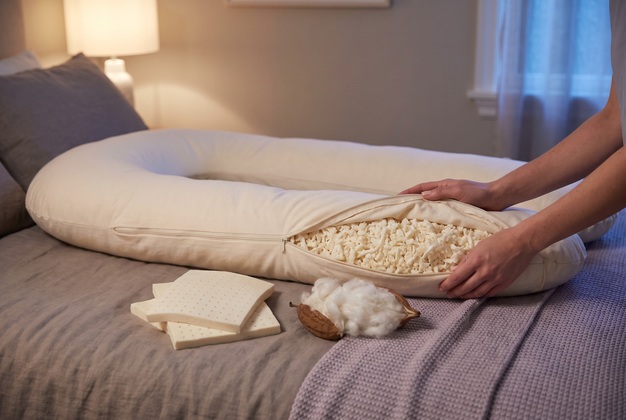
If it has a zipper, usually yes. Eleven of the pages we read say you can add or remove fill (dataset). Loose fill is sold by weight; one seller offers organic shredded latex in bags sold by the pound (Bean Products).
Does the law label tell you how much fill is inside?
No. A California law label states fill materials by percentage of weight (California's labeling regulation). A label reading all wool says nothing about how many pounds of wool you are getting.
Where can you get the survey data?
The full count is published as a CSV file you can download and sort. The method section above explains what each yes means.
Sources
Gathered here, the outside pages this body pillow guide quotes, each beside the part of the guide that needed it.
- Holy Lamb Organics (holylamborganics.com), needed in “Key Takeaways”; “How much fill do makers say goes into a natural body pillow?”; “Why does the same body pillow show different fill weights on different pages?”; “Common questions”.
- DIY Natural Home (diynaturalhome.com), needed in “How much fill do makers say goes into a natural body pillow?”; “Common questions”.
- Pillows.com (pillows.com), needed in “Key Takeaways”; “Why does the same body pillow show different fill weights on different pages?”.
- The Futon Shop (thefutonshop.com), needed in “How much fill do makers say goes into a natural body pillow?”; “Common questions”.
- Back Support Systems (backsupportsystems.com), needed in “How much fill do makers say goes into a natural body pillow?”.
- Amazon listing (amazon.com), needed in “How much fill do makers say goes into a natural body pillow?”.
- Oly Bed Store (olybedstore.com), needed in “Why does the same body pillow show different fill weights on different pages?”; “What does "made in the USA" on a pillow page have to mean?”.
- The Natural Sleep Store (thenaturalsleepstore.com), needed in “Why does the same body pillow show different fill weights on different pages?”.
- Pram n Proper (pramnproper.com), needed in “Why does the same body pillow show different fill weights on different pages?”.
- The Natural Sleep Store (thenaturalsleepstore.com), needed in “Why does the same body pillow show different fill weights on different pages?”; “What else do makers' pages state, and what do they leave out?”.
- California's labeling regulation (law.cornell.edu), needed in “Does the law make a maker tell you how much fill is inside?”; “Common questions”.
- California's net weight rule (law.cornell.edu), needed in “Does the law make a maker tell you how much fill is inside?”.
- ComplianceGate (compliancegate.com), needed in “Does the law make a maker tell you how much fill is inside?”.
- FTC booklet, copy hosted by a label maker (rapidtags.com), needed in “Does the law make a maker tell you how much fill is inside?”.
- earthSake (earthsake.com), needed in “What else do makers' pages state, and what do they leave out?”.
- Tranwin (tranwin.asia), needed in “How can you check a certificate that a maker names?”.
- Delogue (delogue.com), needed in “How can you check a certificate that a maker names?”.
- Holland & Knight (hklaw.com), needed in “What does "made in the USA" on a pillow page have to mean?”.
- CASRAI (casrai.org), needed in “What does "made in the USA" on a pillow page have to mean?”.
- Kelley Drye (kelleydrye.com), needed in “What does "made in the USA" on a pillow page have to mean?”.
- PMA (thepma.org), needed in “What does "made in the USA" on a pillow page have to mean?”.
- Bean Products (beanproducts.com), needed in “Common questions”.